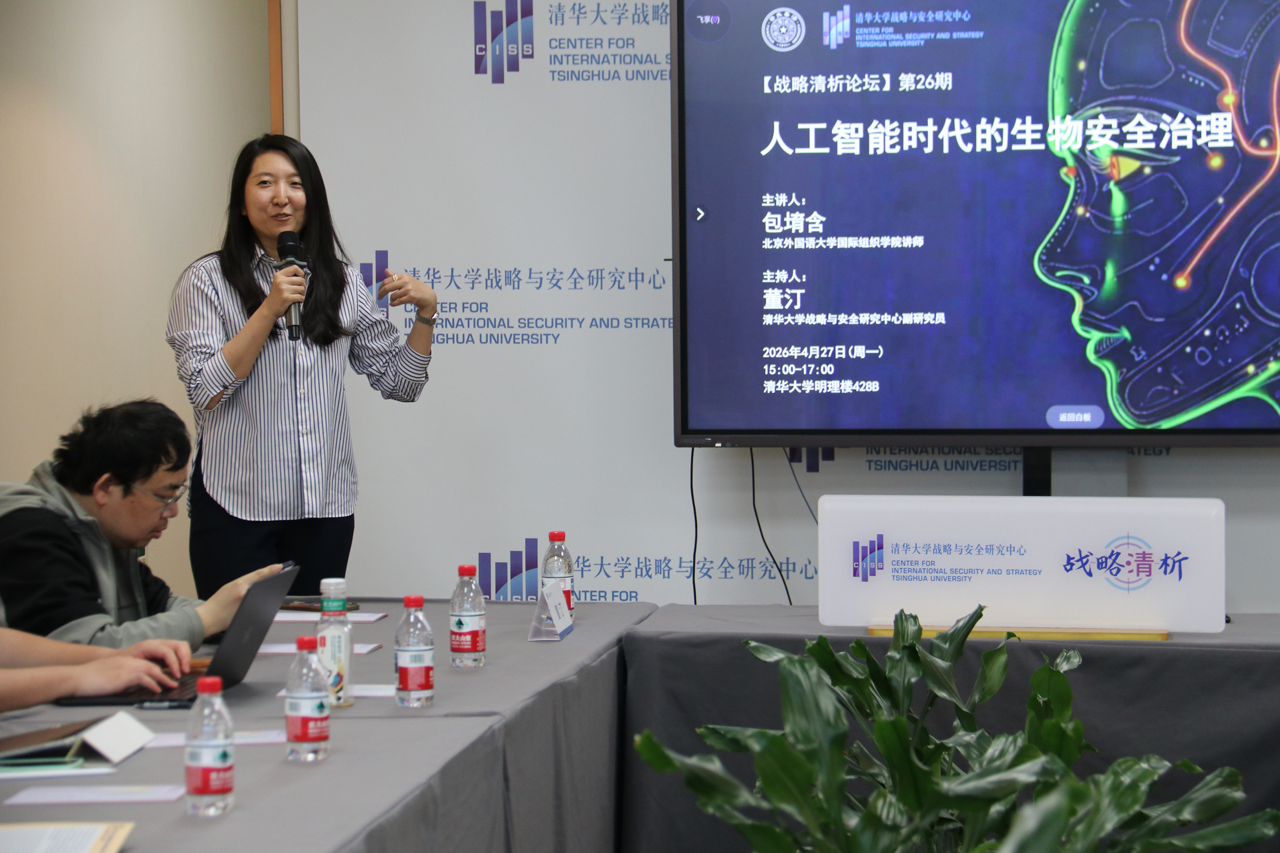
On September 29, 2026, the Center for International Security and Strategy (CISS) at Tsinghua University successfully held the 29th session of “CISS SratFocus”, themed “Australia’s South Pacific Security Strategy”. The forum was moderated by Sun Chenghao, Fellow at CISS. Ning Tuanhui, Associate Research Fellow and Deputy Director at Editorial Department at the China Institute of International Studies, was invited to deliver the keynote speech. Qin Sheng, Director of the Chinese academy of social sciences, Australia, New Zealand research center in the south Pacific and Associate Professor at the University of Chinese Academy of Social Sciences, and Lin Duo, Assistant Research Fellow in the Department for Asia-Pacific Studies at the China Institute of International Studies, participated as discussants.

Ning Tuanhui first systematically elaborated on Australia’s strengthening of security cooperation with Pacific Island countries in recent years. He noted that the South Pacific is vast and rich in marine resources. Although Pacific Island countries have limited comprehensive strength, they possess certain influence in UN voting and in the fields of ocean and climate governance. The history of four rounds of great-power competition in modern times has profoundly shaped Australia’s perception of regional security. At present, regional competition has expanded to comprehensive security dimensions such as policing, infrastructure, and climate. Pacific Island countries generally adhere to a diplomatic approach of “making many friends and not making enemies”, relying on collective strategy to enhance their bargaining power. Australia currently regards the South Pacific as a long-term arena of competition and seeks to become the primary security partner of the island countries, using aid to leverage security influence, building a network of bilateral treaties, and promoting the “Pacific Policing Initiative”. Its security strategy displays four major characteristics: deep integration of security and development, institutionalization of cooperation treaties, constraints on cooperation between island countries and third parties, and the movement of some defense cooperation toward alliances. Although this strategy can bring island countries dividends in funding and capacity-building, it will compress the space for external cooperation of some countries. There is a mismatch between Australia’s agenda and the realistic demands of the island countries, which also increases the difficulty for the island countries to balance great-power relations. For Australia itself, the policy has strengthened its regional influence and its value in coordination within the US-Australia alliance. The United States and Australia divide labor and cooperate to jointly prevent extra-regional forces from intervening. At the same time, Australia has generalized the concept of security, objectively interfering with normal cooperation between China and island countries and increasing the difficulty of China and Australia managing their differences in the South Pacific.

Qin Sheng analyzed the motivations behind Australia’s shift in its South Pacific policy. He said that Australia’s security perceptions first depended on Britain and, after World War II, on the United States, and that it long served as America’s “deputy sheriff” in the South Pacific; its original aid to island countries had poor implementation results. China’s practical cooperation with Pacific island countries has achieved a series of results, undermining Australia’s traditional advantages. Coupled with signs of US strategic retrenchment, Australia has developed anxiety about a power vacuum, and has therefore accelerated the signing of security treaties with island countries. However, although Australia seeks regional autonomy, it is difficult for it to break free from the US-Australia alliance framework.

Lin Duo interprets the inherent contradictions in Australia’s regional diplomacy from the perspective of middle-power diplomacy. He notes that the Labor government has established an “enhanced middle power” positioning and built a four-tier concentric-circle interests architecture. Driven by multiple factors – including changes in the international order, adjustments in the Indo-Pacific landscape, declining confidence in U.S. security commitments, and a structural mismatch between domestic and external economic security – Australia has vigorously engaged the South Pacific. On the one hand, this diplomacy expands Australia’s diplomatic space and enhances its rule-shaping capacity; on the other hand, it exacerbates risks of regional bloc formation and exclusivity. There is an inherent tension between pursuing strategic autonomy while unable to do without the U.S.-Australia alliance, and between seeking to ease relations with China while implementing security denial in the South Pacific. The South Pacific situation may bring new uncertainties to China-Australia relations, and whether the pattern of economic cooperation coexisting with security confrontation can be sustained remains to be observed. Although middle powers can proactively shape strategic space, the actual effectiveness of Australia’s relevant policies still needs time to be tested.

After the keynote and discussion sessions, moderator Sun Chenghao posed two sets of discussion questions: first, based on Australia’s own self-perception, what role does it play among middle powers; and second, moving beyond Australia’s own narrative, how should Chinese scholars define Australia’s regional role. The forum then entered the Q&A interaction session, where faculty and students engaged in extensive exchanges with the experts on topics such as the conceptual connotations of middle powers and strategies in the contest over Pacific Island countries. Drawing on the entire discussion, Sun Chenghao summarized core points including the geopolitical characteristics of the South Pacific, the history of great-power competition, and the internal logic of Australia’s South Pacific security strategy. The participating experts agreed that the South Pacific has once again become a focal point of global geopolitical competition. In recent years, Australia has accelerated its South Pacific security layout by leveraging bilateral treaties and multilateral mechanisms. This policy of tying development assistance to security constraints, while reshaping the regional order, has also generated new sovereignty tensions and challenges in great-power interaction.



This session of StratFocus systemically examines the origins and evolution of Australia’s South Pacific security strategy and its multiple geopolitical implications, offering diverse perspectives and useful references for academic analysis of the South Pacific geopolitical landscape and for Oceania regional studies.


 2026-10-16