Artificial Intelligence Program
2026-09-27 |
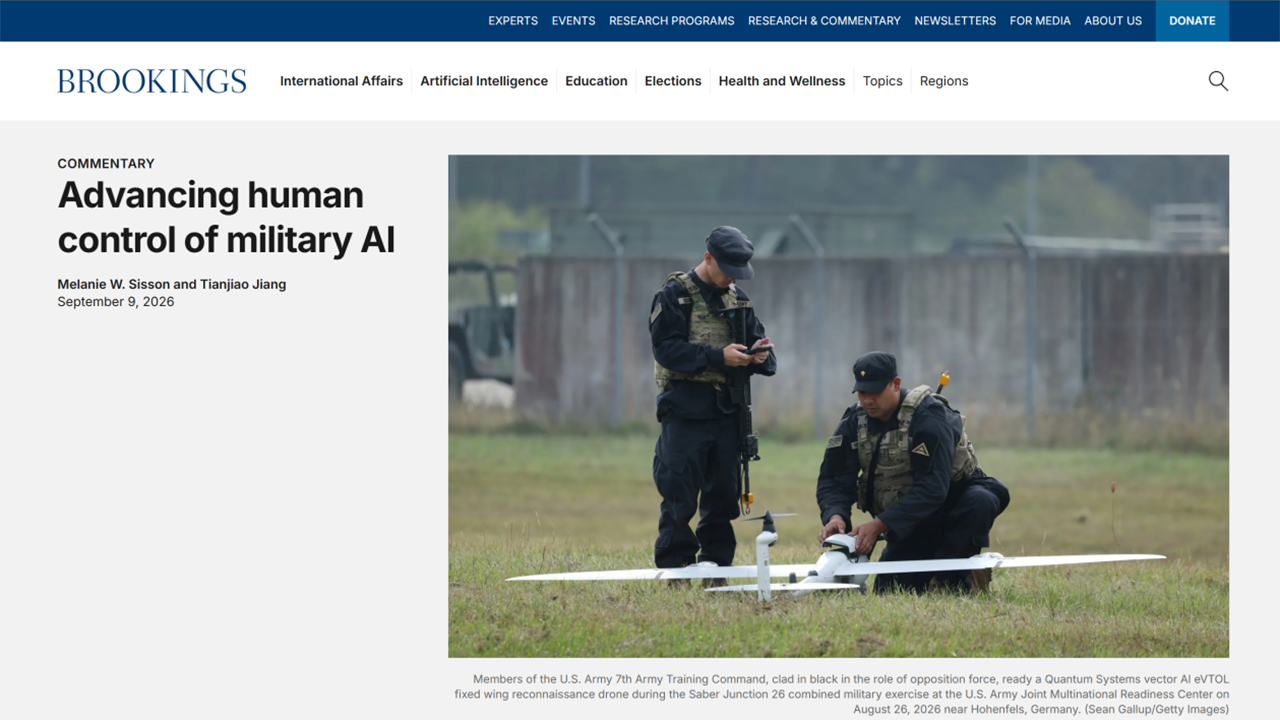
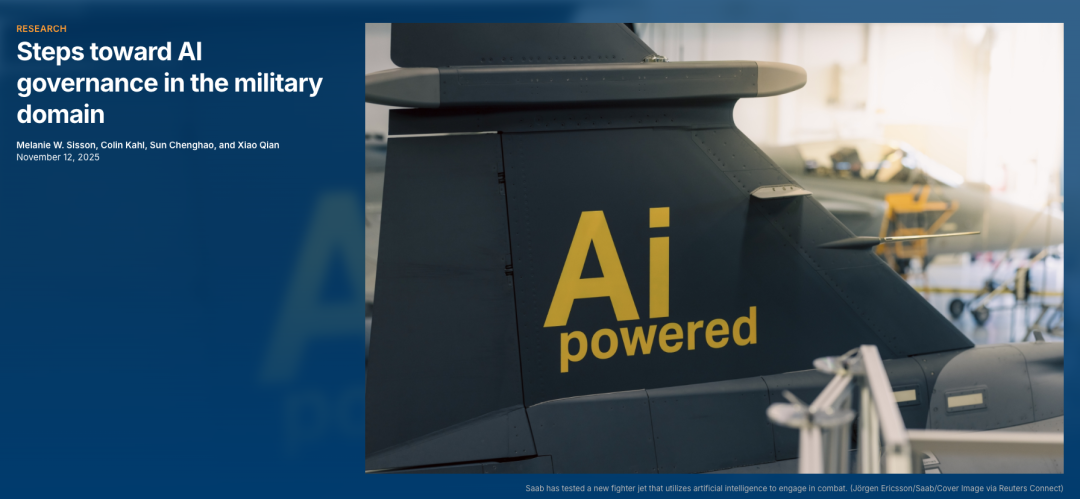
In May 2026, during their meeting in Beijing, the Chinese and U.S. heads of state held constructive exchanges on artificial intelligence and agreed to launch an intergovernmental dialogue on AI. Against this backdrop, members of the “Track 2 Dialogue on China-U.S. AI and International Security,” established jointly by the Center for International Security and Strategy (CISS) of Tsinghua University and the Brookings Institution, drew on their experience from previous exchanges to further explore the governance of artificial intelligence in the military domain, with a view to promoting constructive engagement between the two countries in this area. This article was first published on the Brookings website and is reproduced here for the benefit of our readers.
2026-08-18 |
In May 2026, during their meeting in Beijing, the heads of state of China and the United States held constructive exchanges on artificial intelligence and agreed to launch an intergovernmental dialogue on AI. As two major AI powers, China and the United States should work together to advance the development and governance of artificial intelligence, so that AI can better serve the progress of human civilization and the shared well-being of the international community. Since October 2019, the Center for International Security and Strategy (CISS) of Tsinghua University and the Brookings Institution have jointly held the China-U.S. Track 2 Dialogue on Artificial Intelligence and International Security, conducting a total of 14 rounds of discussions on issues related to artificial intelligence.
2026-06-18 |
From 2024 to 2025, the Center for International Security and Strategy (CISS) at Tsinghua University and the Centre for Humanitarian Dialogue co-hosted a series of four dialogues between Chinese and European experts on the potential risks arising from the development of artificial intelligence technologies and their impact on international security.
2026-05-27 |
Artificial intelligence (AI) technologies are currently being widely applied in humanitarian action, offering significant potential to improve efficiency. However, they also bring potential security risks and challenges. Against this backdrop, the Center for International Security and Strategy (CISS) at Tsinghua University, in collaboration with the International Committee of the Red Cross (ICRC), held the Symposium on the Responsible Use of Technology in Humanitarian Action in Beijing from December 4 to 5, 2025.
2026-05-12 |
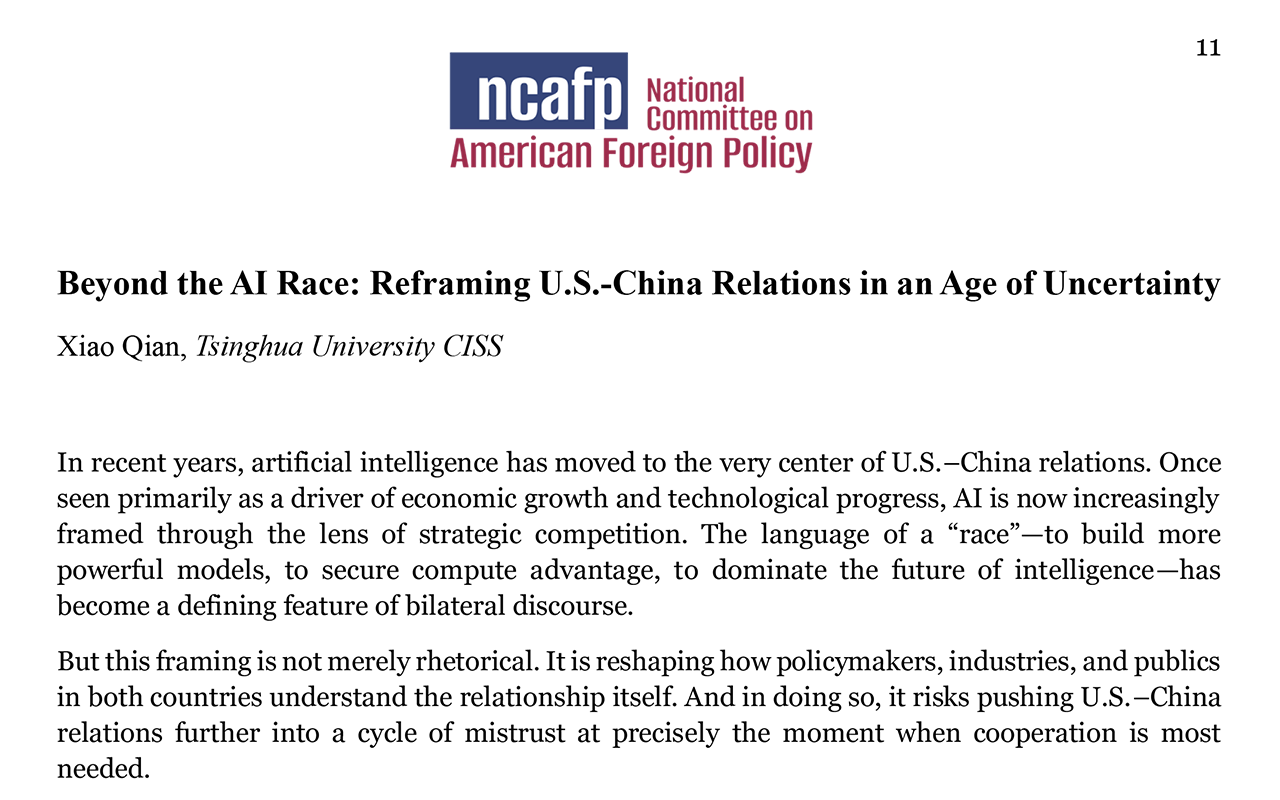
In recent years, artificial intelligence has moved to the very center of U.S.-China relations. Onceseen primarily as a driver of economic growth and technological progress, AI is now increasinglyframed through the lens of strategic competition. The language of a "race"-to build morepowerful models, to secure compute advantage, to dominate the future of intelligence-hasbecome a defining feature of bilateral discourse.
2026-04-26 |
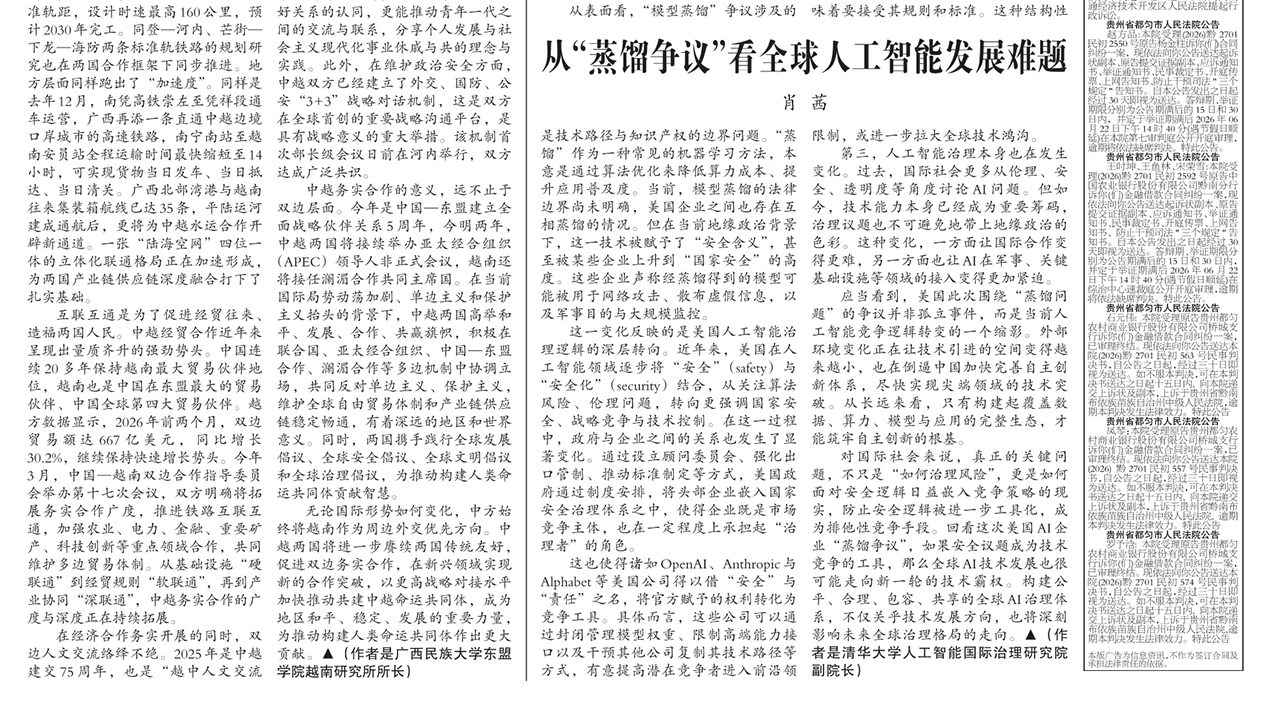
围绕人工智能(AI)企业“模型蒸馏”的争议近日迅速升温,OpenAI、Anthropic与Alphabet等美国头部企业罕见采取协调行动,引发国际舆论关注。AI“蒸馏”,通俗来讲就是让一个AI模型,通过与另一个模型的交互去学习其“做题思路”,从而获得更多本领。
2026-04-02 |
Bangladesh’s garment industry employs around 4 million workers. Their labour built something larger than an export sector – it built a tax base. The industry generates more than 80 per cent of the country’s export earnings and contributes roughly 11 per cent of its GDP. The taxes paid by workers and the wider economy they sustain fund a meaningful share of Bangladesh’s public schools and basic healthcare.
2026-03-24 |
Based on these exchanges, this report focuses on exploring the possible pathways through which non-state actors may misuse AI, the associated risks, and the potential implications for international security. It also analyzes how these risks can be mitigated at both the national level and
through international cooperation. The report aims to provide a reference for understanding this complex issue and to contribute constructive insights to ongoing policy discussions.
2025-11-18 |
Since October 2019, the Brookings Institution’s Foreign Policy Program and the Center for International Security and Strategy (CISS) at Tsinghua University have jointly organized a U.S.–China Track II Dialogue on Artificial Intelligence and National Security. This article is co-authored by members of the U.S. and Chinese delegations who participated in the dialogue. The excerpt presented here reflects the perspectives of Xiao Qian, Deputy Director of CISS and Vice President of the Institute for AI International Governance at Tsinghua University.
2025-09-16 |
Risk dominates current discussions on AI governance. This July, Geoffrey Hinton, a Nobel and Turing laureate, addressed the World Artificial Intelligence Conference in Shanghai. His speech bore the title he has used almost exclusively since leaving Google in 2023: "Will Digital Intelligence Replace Biological Intelligence?" He stressed, once again, that AI might soon surpass humanity and threaten our survival.
2025-09-10 |
America’s AI Action Plan reveals the close ideological alignment of the Trump administration with the “tech right,” such as permissionless innovation, anti-woke AI and pro-capital innovation culture.
2024-04-28 |
The rapid advancement of artificial intelligence technology and its applications have drawn significant attention globally. In 2023, the release of OpenAI’s powerful ChatGPT 4.0 sparked intense competition between enterprises and laboratories to develop large language models. This year, OpenAI unveiled Sora, a tool for creating realistic short videos, demonstrating AI’s immense potential.