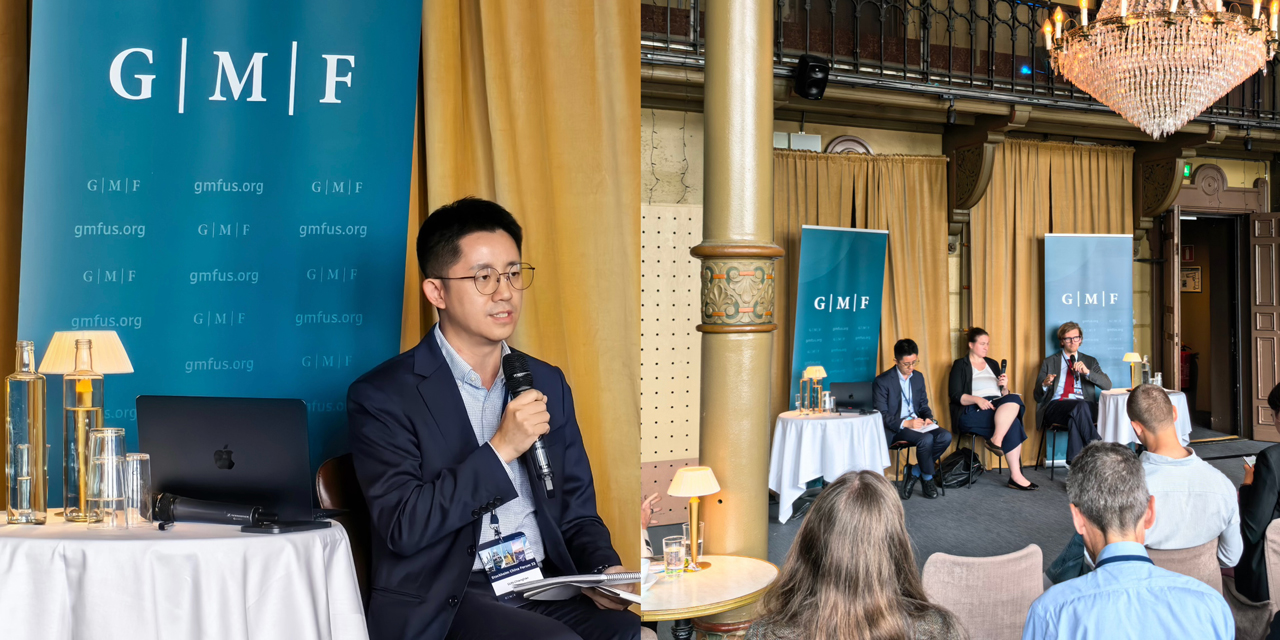
From June 4 to 5, Sun Chenghao, Associate Fellow at the Center for International Security and Strategy (CISS), Tsinghua University, participated in the 33rd Stockholm China Forum in Stockholm, Sweden. During the forum, Sun joined a panel discussion on China-U.S. artificial intelligence (AI), exchanging views with experts from Europe and the United States on AI development in China and the United States, AI governance, and prospects for international cooperation. He also engaged in multiple rounds of discussion with participants during the Q&A session.
In his remarks, Sun observed that competition between China and the United States in AI has expanded well beyond individual technologies to encompass multiple dimensions, including advanced chips and computing power, foundation models, data resources, talent ecosystems, industrial applications, and digital infrastructure. While the United States maintains strengths in advanced semiconductors, frontier AI models, innovation ecosystems, and venture capital investment, China has demonstrated comparative advantages in industrial applications, large-scale deployment, infrastructure integration, and the adoption of AI across the real economy. AI competition, he noted, increasingly reflects not only technological capabilities but also broader national strengths in industrial systems, innovation capacity, and governance.
Discussing prospects for China-U.S. cooperation on AI, Sun emphasized the value of maintaining government-level dialogue to enhance mutual understanding, reduce strategic misperceptions, and contribute to global AI governance. Given the wide-ranging challenges posed by the rapid development of AI, he suggested that the two countries pursue differentiated channels of communication and cooperation according to the nature of specific issues. In the field of AI governance, both sides could strengthen exchanges on shared concerns such as deepfakes, cyber fraud, AI misuse, and the protection of critical infrastructure. In the area of social governance, they could share experiences on the impact of AI on employment, education, privacy protection, and the well-being of minors. On security issues, he highlighted the importance of dialogue on AI and strategic stability, military applications of AI, and crisis communication mechanisms. He also noted that Track II dialogue offers a valuable platform for advancing discussions on these issues by fostering mutual understanding, generating policy recommendations, and laying the groundwork for future institutionalized cooperation.
Sun further noted that, as the world's two leading AI powers, China and the United States are not only major drivers of AI innovation but also key stakeholders in global AI governance. He suggested that the two countries strengthen communication and coordination within multilateral frameworks such as the United Nations and explore cooperation in areas including AI safety evaluation, the protection of critical infrastructure, capacity building, and AI development in the Global South, thereby contributing more international public goods to the global governance of artificial intelligence.