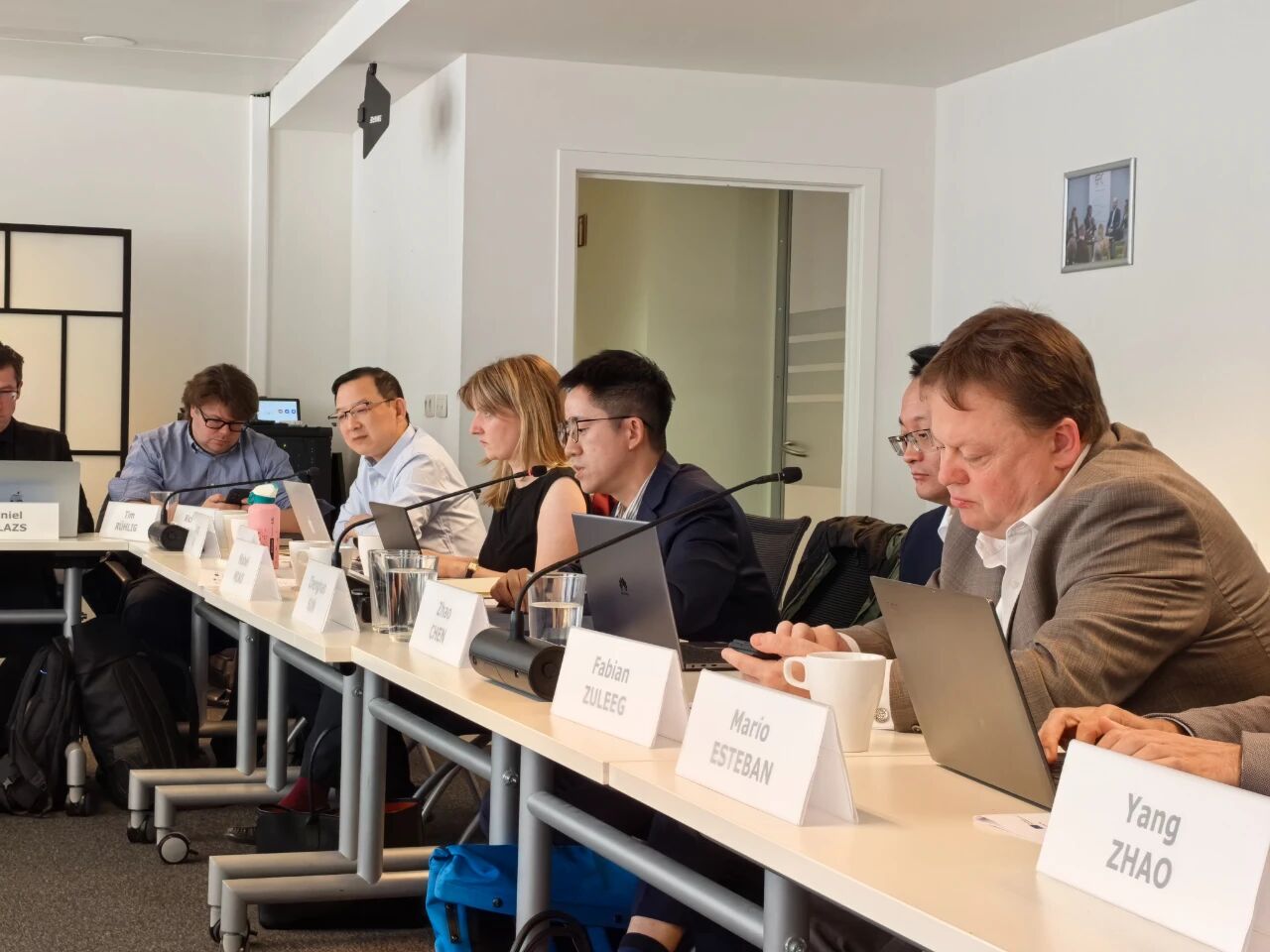
On June 8, Sun Chenghao, Fellow at the Center for International Security and Strategy (CISS), Tsinghua University, was invited to participate in a China-Europe think tank dialogue hosted by the European Policy Centre (EPC) in Brussels, Belgium. Scholars and experts from leading think tanks, universities, and research institutions in China and Europe exchanged views on China-Europe relations, economic and trade cooperation, global security, and the international order.
During the panel discussion on "Global Security Transformation: Chinese and European Perspectives," Sun joined scholars from China and Europe in discussing changes in the international security environment, differences in Chinese and European security perceptions, and prospects for future cooperation.
Sun observed that the international security landscape is undergoing profound transformation. Rather than being characterized by a single crisis, today's security environment reflects the interaction and spillover of multiple challenges, including major-power competition, regional conflicts, emerging technologies, economic security, and deficits in global governance. As a result, traditional and non-traditional security issues have become increasingly intertwined, contributing to a more complex and uncertain global security environment.
Discussing major-power relations, Sun noted that competition and risk management are increasingly developing in parallel. Taking China-U.S. relations as an example, he pointed to recent discussions on building a constructive strategic stability relationship, arguing that both sides have come to recognize the need to place competition within agreed boundaries and supported by effective risk-management mechanisms. For Europe, he suggested that maintaining strategic autonomy and independent judgment amid intensifying major-power competition remains an important policy challenge.
On the implications of emerging technologies for international security, Sun argued that advances in artificial intelligence, autonomous systems, cyberspace, outer space, and big data are fundamentally reshaping the nature of warfare and the security environment. The conflict in Ukraine, he noted, has demonstrated that modern warfare increasingly depends not only on military capabilities but also on technological innovation, industrial capacity, and data resources. At the same time, emerging technologies may compress decision-making timelines during crises, increasing the risks of miscalculation and unintended escalation. He emphasized that efforts to strengthen defense capabilities should be accompanied by greater attention to crisis communication, transparency, and risk-reduction mechanisms to ensure that technological innovation and security governance evolve together.
Sun also highlighted the growing interconnections among major international security challenges, including the conflict in Ukraine, developments in the Middle East, security in the Red Sea, the Iranian nuclear issue, and the security situation in the Asia-Pacific. He argued that the impacts of these issues increasingly transcend regional boundaries through channels such as energy markets, food security, maritime shipping, supply chains, and financial markets. Addressing these cross-regional and cross-sector security risks, he suggested, requires closer international coordination and stronger collective crisis-management capabilities.
Turning to the role of Europe and China-Europe cooperation, Sun argued that Europe is not only an important participant in the global security architecture but also has a role to play in reducing tensions and managing international risks. While safeguarding its own security interests, Europe should continue to preserve space for diplomacy, crisis management, and international cooperation. Despite differences on certain security and geopolitical issues, China and Europe continue to share broad common interests in maintaining international stability, strengthening global governance, and addressing the security challenges posed by emerging technologies.