On October 12, the Sixth Annual TRENDS Conference, hosted by the UAE-based TRENDS Group, was held in Abu Dhabi. Jodie Wen, fellow at the Center for International Security and Strategy (CISS), Tsinghua University, and Director of Media and Communications for the China Forum, was invited to attend and deliver a presentation during a panel discussion.
Themed “Sustainable Security: The Post-War Future of the Middle East,” the conference focused on the impact of the U.S.–Israel–Iran military conflict on the regional security architecture, strategic partnerships and geo-economic landscape. It brought together participants from government, academia and business around the world, including Admiral Brad Cooper, Commander of U.S. Central Command; Mike Waltz, U.S. Ambassador to the United Nations; and Mike Pompeo, former U.S. Secretary of State. Participants held four panel discussions on the future of deterrence and regional security, competing narratives in the information domain, strategic partnerships and shifts in the balance of power, and energy and trade security amid geo-economic competition.
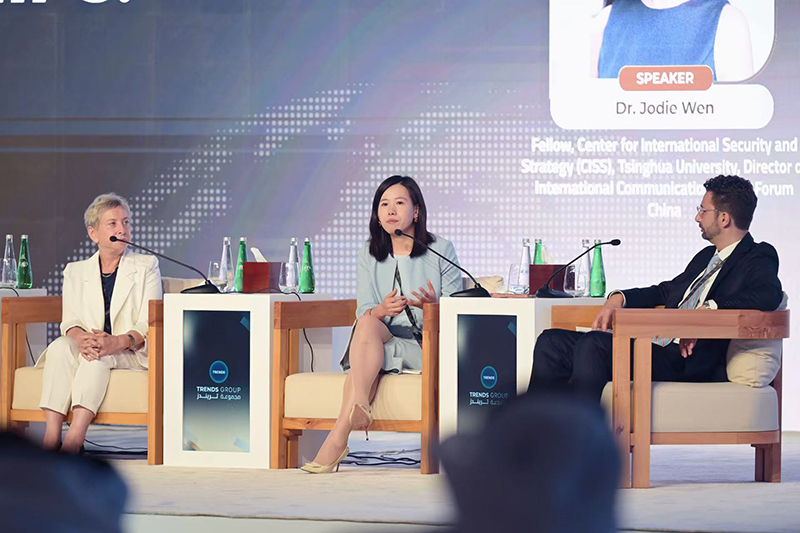
Jodie WEN was invited to speak on the panel “Power Through Partnerships: Alignments Reshaping the Balance of Power,” moderated by Bilal Saab, Senior Managing Director of TRENDS US and a former senior adviser at the U.S. Department of Defense. The other panelists were Irina Zvyagelskaya, Head of the Center for Middle East Studies at the Primakov National Research Institute of World Economy and International Relations (IMEMO), Russian Academy of Sciences; Barın Kayaoğlu, Chair of American Studies at Ankara Social Sciences University; and Mihai Sebastian Chihaia, Policy Director of the Europe in the World Programme at the European Policy Centre.
Jodie focused on China’s Middle East policy amid regional conflict, particularly the relationship between economic engagement and security involvement. She argued that the war had disrupted China’s trade and economic ties with regional countries, as well as people-to people exchanges, while prompting regional states to reassess the role of external partners in regional security. She emphasized that China’s commitment to non-alignment and its policy of not taking sides provided an important foundation for building trust with regional countries and positioning China as a potential diplomatic mediator.
China's involvement in facilitating the normalization of relations between Saudi Arabia and Iran illustrated the value of this policy. At the same time, deeper economic and trade ties did not necessarily translate into a greater military or security role. Economic cooperation should not be conflated with an expanded military and security presence. Regional countries have the capacity to address their own challenges, and greater emphasis should be placed on resolving conflicts through diplomacy and other peaceful means.
During her stay in the UAE, Jodie also visited institutions in the United Arab Emirates, the Abu Dhabi Department of Finance, United Arab Emirates University, Mohamed bin Zayed University of Artificial Intelligence (MBZUAI), and The National, and held discussions with university faculties and members of the business community on the situation in the Middle East, China–UAE economic and trade cooperation, and cooperation between Chinese and Emirate media.


 2026-10-28