Fu Ying in Dialogue with Iceland’s Former President Grímsson: The Claim of a “Chinese Threat to the Arctic” Is a Figment of Imagination; Melting Glaci
“So much geopolitical discussion today is built on imagined threats, which is simply a waste of time. For the Arctic, the top priority at present is the ongoing transformation of its natural environment — sea ice is melting, ice sheets are shrinking, temperatures are rising… These are the real problems we need to care about.”
From October 8 to 10, local time, the 2026 Arctic Circle Assembly convened in Reykjavík, capital of Iceland. During the forum, Fu Ying, Former Vice Minister of Foreign Affairs of China , engaged in a dialogue with Ólafur Ragnar Grímsson, former President of Iceland and Chairman of the Arctic Circle Assembly. She made the above remarks in response to allegations that China poses a “security threat” in the Arctic.
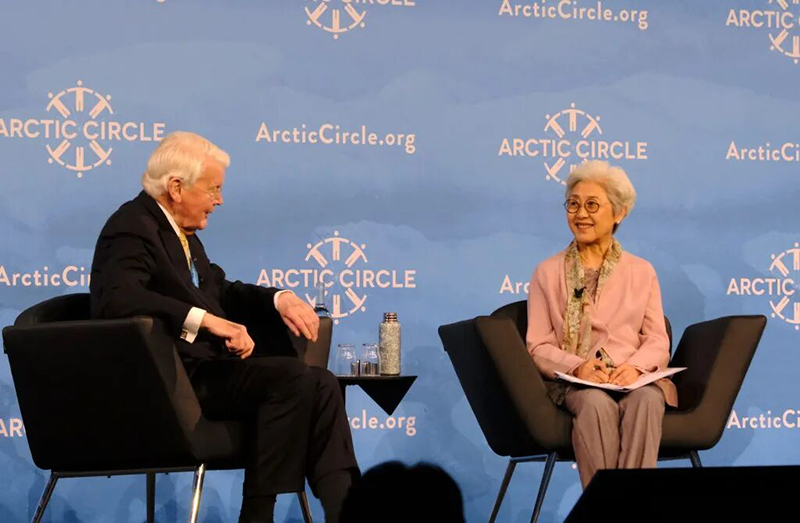
Fu Ying led the Chinese delegation to the Assembly and was invited to hold a dialogue with Grímsson at the plenary session themed “Understanding China.” She also took questions from the audience on site. Their conversation spanned multiple dimensions of China’s relations with the world, covering China’s development and transformation, Western perceptions of China, Arctic affairs, international security, world multipolarity, and China-Europe relations.
The dialogue opened with Fu Ying’s personal experience. Grímsson noted that Fu Ying, born in 1953, has witnessed China’s dramatic transformation over more than half a century from an impoverished nation into a major global power, and invited her to elaborate on how Europeans should understand the changes unfolding in China.
Fu Ying stated that there are many perceptions and quite a few misunderstandings about China abroad. Boasting a rich culture and profound historical heritage, China is indeed not easy to fully comprehend.
When speaking about China’s decades-long development, Fu Ying started with its industrial system. At the founding of the People’s Republic of China, the country had a weak foundation. After decades of development, it has achieved remarkable accomplishments and established a complete industrial system covering all industrial categories in the UN industrial classification, including more than 600 subcategories. This explains why it is difficult to win a trade war against China.
For most ordinary Chinese people, Fu Ying said, national success is not an abstract concept. It translates into tangible realities: having enough to eat, equal access to education, jobs, and healthcare security, among others.
China’s population is roughly three times that of Europe. Feeding its people has long been a core priority for the Communist Party of China and the Chinese government. While advancing rapid industrial growth, China has consistently increased investment in agriculture. The annual Central Government “No.1 Document” always focuses on agricultural issues. In 2006, China abolished the agricultural tax, marking the point when industry began to support agriculture. In the new era, China reached a milestone: in 2020, it won the battle against poverty, lifting nearly 100 million rural poor people out of poverty.
Moving from China’s own development experience, Grímsson shifted to how the outside world perceives China. He asked: Today, Western countries increasingly view China through the lens of capabilities, even as a threat, and some seek to constrain China’s development. How do you understand the contrast between your own lived experience and Western perceptions of China?
Fu Ying replied that a nation’s allocation of resources and attention shapes its future trajectory. For decades, China has focused on economic development, rising from extreme poverty to become the world’s second-largest economy.
China’s established goal is to basically achieve socialist modernization by 2035, with per capita GDP reaching the level of moderately developed countries — roughly one-third of Iceland’s current level. China’s development and construction always require a peaceful and stable international environment. Externally, it pursues international cooperation to create and safeguard favorable international conditions for development. At the same time, China must build necessary national defense capabilities to defend its own security and uphold world peace. In this regard, substantial progress has also been made. The people have greater confidence that the country can pursue independent development free from bullying and manipulation by external forces.
Fu Ying also talked about how China views its growing international influence.
She noted that China is now widely regarded as one of the world’s major powers. The international community wonders what China seeks and what it can offer to the world. Chinese people are also reflecting on how to assume greater international responsibilities.
“China has no intention of vying for global hegemony, nor does it believe the world needs a new hegemon,” Fu Ying said. China follows a path of peaceful development, one not built on foreign wars, military conquest, or expanding spheres of influence.
She added that President Xi Jinping has proposed building a community with a shared future for mankind, together with the Global Development Initiative, Global Security Initiative, Global Civilization Initiative and Global Governance Initiative, injecting certainty into the world. Going forward, China will stay committed to peaceful development and actively foster a more just and equitable global governance system.
Fu Ying mentioned that China provides global public goods through initiatives such as the Asian Infrastructure Investment Bank and the Belt and Road Initiative. While there were doubts in the early days, more than a decade of practice has proven China has honored its commitments, and the Belt and Road Initiative has grown into an important platform for international cooperation.
The conversation then turned to the Arctic, the host region of the forum. Grímsson raised that some Western figures portray China as a potential security threat in the Arctic and cite this as grounds to ramp up military deployments there. Yet China is focused on domestic development to deliver better lives for its 1.4 billion people. How does China demonstrate that it does not constitute the so-called “security threat,” given these two starkly contrasting narratives?
Fu Ying responded: I often hear claims of a “China threat,” much of which is imagined. Some say they feel threatened simply because China is large. China is indeed a big country with a massive population, yet a country’s intentions and capabilities cannot be judged through conjecture.
She posed a rhetorical question: “I fail to understand why people claim China poses a threat in the Arctic. No one is going to fight a war there, just think about the weather!”
Fu Ying went on to say that the top priority facing the Arctic today is the ongoing deterioration of its natural environment: sea ice melting, ice sheet shrinkage and rising temperatures. These are the real issues demanding attention.
China has a long coastline with densely populated and economically developed coastal zones, and we are highly sensitive to the consequences of sea level rise, she said. All parties should pool their strengths and resources to jointly study these changes, understand practical challenges ahead, and get prepared in advance.
Fu Ying also noted that the joint statement issued by Chinese and Icelandic leaders last year highlighted cooperation on addressing climate change and green energy. Such tangible cooperation speaks louder about China’s policies and intentions than threat narratives rooted in imagination.
On China’s relations with neighboring countries, Fu Ying said many of China’s Asian neighbors are smaller nations. While China has disputes and differences with some neighbors, it stays committed to peacefully settling disputes through dialogue and negotiation. It also prioritizes cooperation with all countries to convince them that cooperation yields a better future than confrontation. China has made tremendous efforts and exercised considerable restraint in this regard.
Asia has emerged as a major global manufacturing hub and a key driver of economic globalization, she said. Why has Asia achieved such growth? The vast majority of countries uphold the principles of equality and peaceful coexistence, keeping their focus on development and cooperation. Every nation has a seat at the table; none is on the menu.
During the fireside chat between Fu Ying and Grímsson, questions from the audience further extended to global governance and international relations.
A journalist asked about China’s proposal of an “equal and orderly multipolar world,” as well as the direction and prospects for multipolarity.
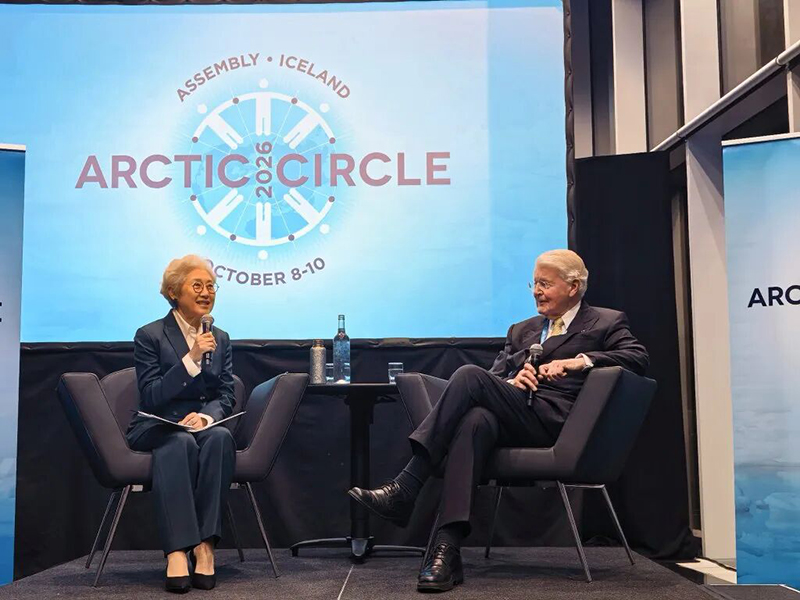
Fu Ying said the world is moving toward multipolarity. No single country or bloc can dominate international affairs any longer. Global issues require joint participation and decision-making by all nations. At present, the international community has not yet reached full consensus on multipolarity. Some nations feel uncomfortable or even anxious about it, while others fear disorder in a multipolar world. China holds that multipolarity is an important trend of global development. Countries need to jointly explore effective global governance mechanisms to steer multipolarity toward an equal and orderly direction.
An official from Greece raised a question: when China’s own interests conflict with those of the international community, how does it balance domestic development and international responsibilities?
Fu Ying said the answer starts with a fundamental assessment of global trends. China’s view is that peace and development remain the mainstream of the times, and most countries want a peaceful world and national development. China’s own development aligns with the overall trend of world development. Fundamentally, there are no irreconcilable contradictions between China’s development and that of other countries.
Countries inevitably have differences on specific issues, including security matters, she noted. The Global Security Initiative proposed by China emphasizes that all countries should work to achieve common security. One country’s security cannot be built at the expense of others’ security — this is a vital principle. When conflicts over security interests arise between nations, dialogue and negotiation should be the first recourse for solutions.
A Belgian university student asked how to advance China-Europe cooperation.
Fu Ying said China-Europe relations have always had ups and downs. Nevertheless, recent China-Europe trade and investment consultations have been pragmatic and productive, yielding multiple consensus points. Notably, both sides agreed to resolve differences within the WTO framework in accordance with WTO rules, which is a positive signal. With mutual respect and earnest dialogue, problems can be readily addressed. China regards Europe as an indispensable component of a multipolar world. But Europe’s future ultimately hinges on the choices Europeans make themselves.
A Chinese student from the audience asked: how to dispel misunderstandings and prejudices as the outside world repeatedly hypes up the China threat theory?
Fu Ying said Chinese people are used to focusing on delivering results and proving ourselves through actions. In today’s information age, actions alone are insufficient. We need to take the initiative to communicate more, to win understanding and trust from abroad. China is already a country with substantial global influence. Young people in China should learn more, truly understand their own nation so they can better tell China’s stories to the world.


 2026-10-13