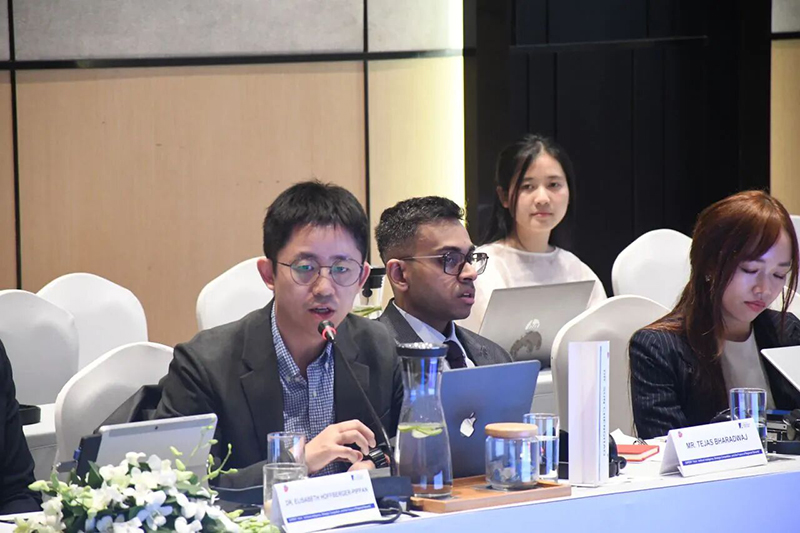
On October 1, a workshop titled "The Future of Artificial Intelligence, Strategic Competition, and Regional Security," co-hosted by the Diplomatic Academy of Vietnam and the Konrad-Adenauer-Stiftung Vietnam Office, was held in Hanoi, Vietnam. Sun Chenghao, Fellow at the Center for International Security and Strategy (CISS) at Tsinghua University, was invited to attend. He delivered a keynote speech titled "China-ASEAN AI Cooperation in the Context of China-U.S. Rivalry" during a panel discussion on "ASEAN and Regional Cooperation in the AI Era," and answered questions from the audience.
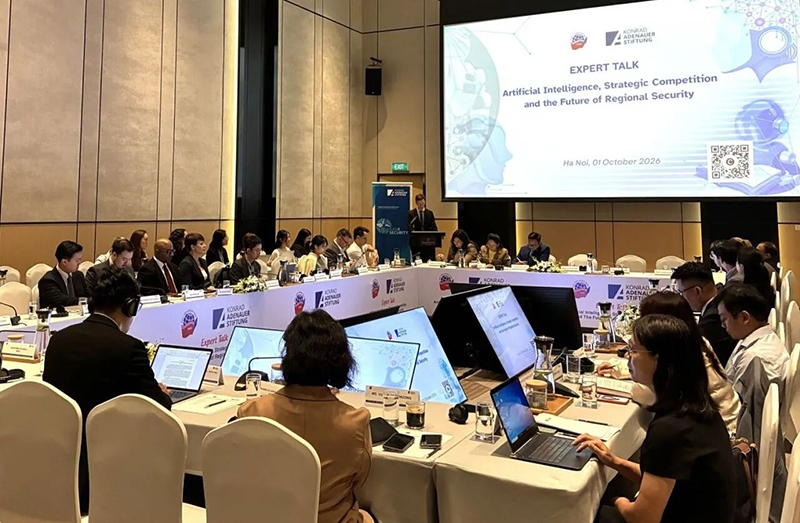
The conference featured discussions on AI and strategic competition, the changing forms of conflict and the security environment in the Indo-Pacific, and ASEAN and regional cooperation. Sun Chenghao stated that China-U.S. AI competition is influencing the policy choices of regional countries, but ASEAN countries have their own development goals and aspirations for strategic autonomy. China's AI cooperation with ASEAN respects ASEAN's centrality and the development gaps among its member states, focuses on addressing concrete development and governance issues, and offers regional countries more options.
Sun Chenghao argued that China-ASEAN AI cooperation has a realistic foundation. China has accumulated experience in foundation models, computing infrastructure, and industrial applications, while ASEAN possesses a diverse linguistic environment, abundant application scenarios, and growing demand for the digital economy. The two sides can combine their respective strengths to promote AI applications in manufacturing upgrading, smart city development, healthcare services, and cross-border e-commerce, and strengthen joint efforts in local language models, data resources, and professional talent development. Both sides also share common concerns regarding development-oriented and people-centered AI governance, and can accumulate cooperation experience on the basis of respecting each country's system and stage of development.
Regarding the challenges facing cooperation, Sun Chenghao noted that external technology restrictions have increased uncertainty in accessing advanced chips, computing power, and related services; ASEAN member states differ in digital infrastructure, talent reserves, and industrial capacity; and national rules on data protection, cybersecurity, and intellectual property are not entirely consistent. These issues make it difficult to scale some cooperation projects across borders. At the same time, as AI applications in the security and military domains continue to evolve, parties still hold differing views on related risks and governance boundaries, necessitating sustained dialogue.
Future cooperation could explore three directions. First, promote more balanced digital infrastructure development by expanding access to computing power, networks, and application services through public-private partnerships and other means, while strengthening talent training so that cooperation outcomes can reach more ASEAN member states. Second, start with non-sensitive, de-identified, and statistical data to explore tiered and classified management, mutual recognition of rules, and general compliance templates, thereby reducing the cost of cross-border cooperation and addressing differences that arise in practice through regular dialogue. Third, leverage regional and multilateral mechanisms to advance open datasets, technical standards, and governance capacity building, including exploring the role that platforms such as the World AI Cooperation Organization could play, so that developing countries can participate more fully in international rule discussions.
Drawing on recent China-U.S. AI dialogue, Sun Chenghao noted that strategic competition has not eliminated the two sides' shared concerns about major AI risks. Establishing communication and notification channels for serious security incidents can help reduce miscalculation. This also has implications for China-ASEAN cooperation: while advancing infrastructure and industrial projects, risk assessments, personnel training, and cross-border information-sharing mechanisms should be pursued in parallel. ASEAN can play a regional coordinating role in helping all parties find a sustainable model of cooperation that balances technological development, security governance, and national autonomy.


 2026-10-14