Wen Jodie Leads Delegation to Switzerland and Germany to Study the AI Industry-Academia-Research Ecosystem
From July 20 to August 3, 2026, Dr. Jodie Wen, Postdoctoral Fellow at the Center for International Security and Strategy (CISS), Tsinghua University, led the Overseas Practice Team from Tsinghua University’s Wuqiong College on an overseas field study in Switzerland and Germany. Setting out from Geneva and traveling across the Alps and the Rhine region, the team visited more than ten academic institutions, international organizations and industrial parks over the course of two weeks. Looking beyond academic papers and data, the team sought to explore what AI development actually looks like on the ground across continental Europe. This question also clearly defined the two main strands of the field study: “the real-world pulse of governance and industry” and “diverse explorations at the academic frontier.”
01 The Real-World Pulse of Governance and Industry
Permanent Mission of China in Geneva
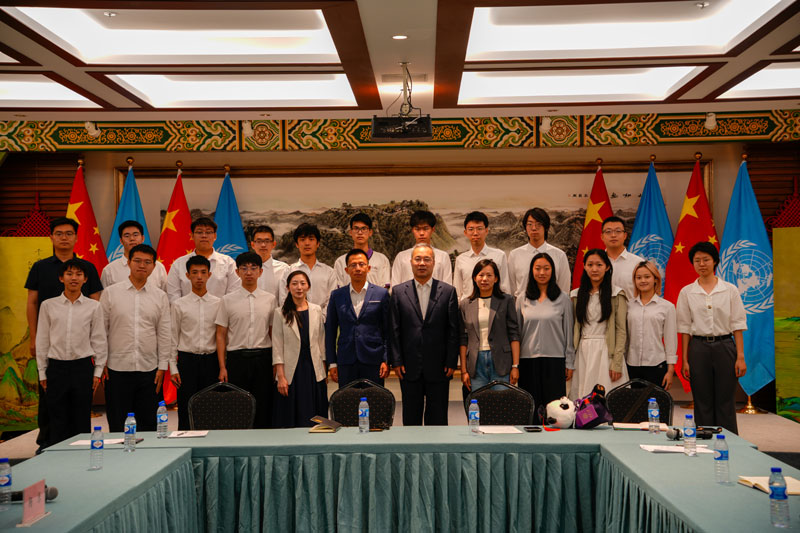
On the morning of July 21, the team visited the Permanent Mission of the People’s Republic of China to the United Nations Office at Geneva and Other International Organizations in Switzerland. As a key institution through which China participates deeply in AI governance discussions under the UN framework, the Mission plays an important role in articulating China’s positions and contributing to international rulemaking.
Counsellor Yu Zhicheng provided a systematic overview of the global AI governance landscape: technological development is outpacing rule-making, countries remain divided in their approaches, and developing countries have yet to gain sufficient voice in the process. China has promoted the adoption by the United Nations of the resolution on “Enhancing International Cooperation on Capacity-Building of Artificial Intelligence,” launched the Artificial Intelligence Capacity-Building Action Plan for Good and for All, and proposed the establishment of the World Artificial Intelligence Cooperation Organization. These efforts represent important practices by a developing country in advancing global AI governance.
Drawing on his work experience at the International Telecommunication Union (ITU), young diplomat Yang Le introduced the concept of “de facto standards”: leading technologies can have greater power to shape rules than norms formulated in advance.
During the open discussion, the students and diplomats engaged in lively exchanges on issues including the voice of developing countries and the development of young professionals. Counsellor Yu told the students, “AI is a young field, and even more so a field for young people.” Yang Le encouraged them: “Do not become too fixated on any one path, but be prepared.”
The visit to the Mission marked the team’s first realization that the development of AI requires not only technological breakthroughs in laboratories, but also institutional innovation through multilateral dialogue.
World Economic Forum
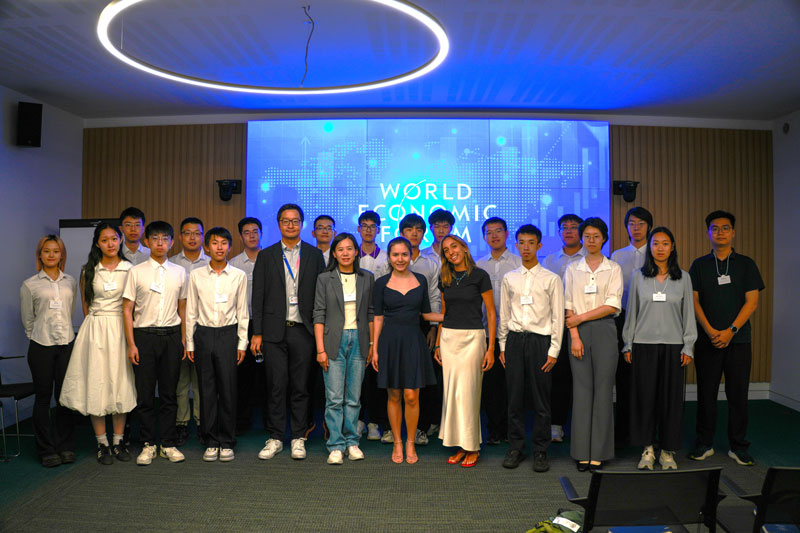
Founded in 1971, the World Economic Forum (WEF) is committed to “improving the state of the world.” Its Centre for AI Excellence, established in 2025 as the Forum’s 11th centre, brings together a community of more than 400 corporate executives focused on AI transformation.
On the afternoon of July 21, the team visited WEF headquarters. Forum experts shared insights in four main areas. First, the global economy is expected to see a net increase of 78 million jobs by 2030, with AI creating more jobs than it displaces. Second, global AI governance faces four major challenges, including fragmentation and uneven levels of maturity. Third, companies have shifted their focus on AI from “Can we do it?” to “What can we use it for?” Fourth, the “3C Framework” for technology convergence shows that competitiveness increasingly stems from “combination” rather than “originality.”
After the session, the students toured the headquarters and discussed career development in international organizations with Xue Boyang. From the Mission’s role as a “rule-maker” to WEF’s role as a “consensus-builder,” the team came to see that governance is not merely the outcome of bargaining and compromise, but also a process of dialogue, research and consensus-building.
Embassy of the People’s Republic of China in Switzerland
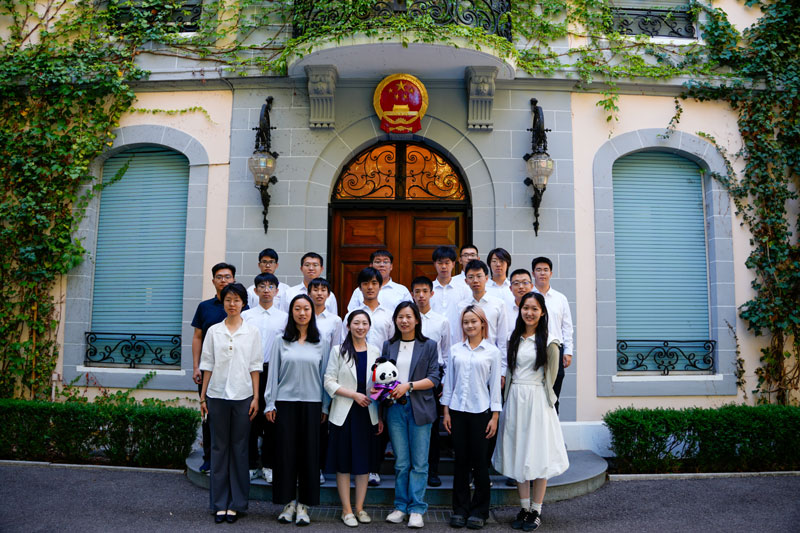
On the afternoon of July 23, the team visited the Embassy of the People’s Republic of China in Switzerland. The visit began with a tour of an exhibition on Premier Zhou Enlai and the diplomacy of New China, followed by a documentary screening. Counsellor Li Xudong delivered welcoming remarks, while Dr. Jodie Wen and team leader Wang Taodi introduced the background of the field study and Wuqiong College, respectively.
Yunzhen Liu, a science and technology diplomat at the Embassy, outlined three stages in the development of Switzerland’s AI strategy: the establishment of a National Centre of Competence in Research (NCCR) in 2010, the development of the “Alps” supercomputer in 2021, and the launch of the Swiss AI Initiative and establishment of the Swiss National AI Institute in 2023.
Linlin Jia, a postdoctoral researcher at the University of Bern, and Chenrui Fan, a PhD student at the university, shared their cutting-edge research on graph machine learning and the evaluation of video generation models. Qin Yan, Zhang Hao and other staff members of international organizations shared their professional experiences and discussed how to develop global competencies.
Through these exchanges, the students gained a comprehensive view of how Switzerland is building its own competitiveness in AI through “precision positioning, a foundation of technological sovereignty, and open collaboration.”
Tsinghua University Alumni Association in Switzerland and Asia Society Switzerland
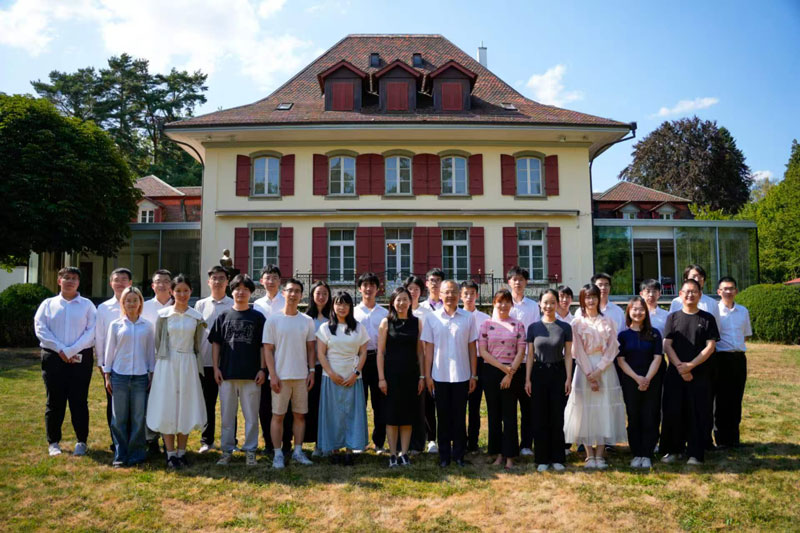
On the morning of July 25, the Tsinghua University Alumni Association in Switzerland held a seminar for the team in the Main Building of ETH Zurich, offering the students insights into Switzerland’s ecosystem linking industry, academia and research, as well as pathways for career development.
Tsinghua alumnus Niandong Fang analyzed the characteristics and structural disadvantages of Europe’s AI landscape across five dimensions: talent, capital, computing power, data and regulation. Europe does not lack homegrown talent, he noted, but many of its top researchers and entrepreneurial teams are drawn to the United States. Fragmented financing, limited computing capacity and linguistic fragmentation, among other factors, have made it difficult for Europe to form a truly unified single market. While the EU AI Act is pioneering, it has also constrained the pace of development.
Drawing on her experience at Novartis and Bayer, Tsinghua alumna Grace Yuying Gao traced Basel’s evolution from a centre of the dye and chemical industries into a global life sciences hub, and stressed that AI applications in the pharmaceutical sector must be verifiable and accountable.
Drawing on her experience from multiple field research trips to the Middle East, Dr. Jodie Wen shared her observations on the conflict involving the United States, Israel and Iran, as well as differences between Chinese and U.S. strategies in the Middle East.
Some team members also visited Asia Society Switzerland, where they engaged in discussions on China-Europe educational exchanges. The alumni’s insights and the dialogue at Asia Society Switzerland gave the students a clearer understanding that competition in AI is not merely technological, but a systemic contest involving institutions, markets and ecosystems.
BMW Museum
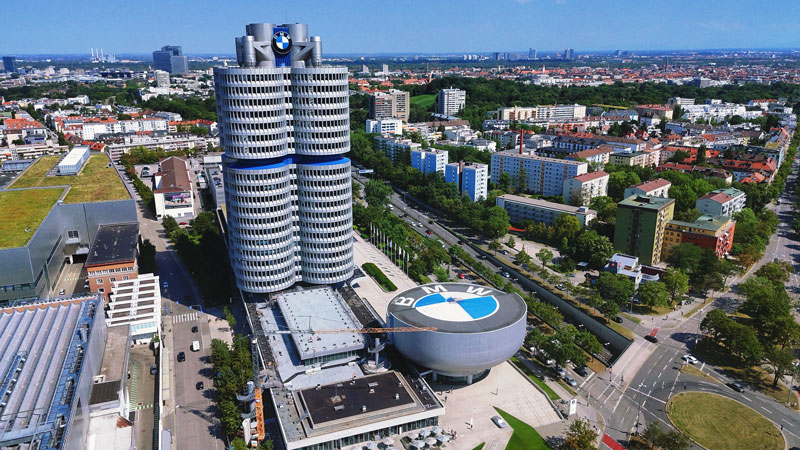
On the afternoon of July 29, the team visited the BMW Museum in Munich. BMW offers a microcosm of the transformation of German manufacturing from precision mechanical engineering to the integration of software and hardware. From aircraft engines a century ago to today’s intelligent driving systems, the museum vividly traces the evolution of German industry, giving the students a tangible sense that AI-driven industrial transformation does not emerge out of nowhere in laboratories, but is gradually embedded in technologies and products built upon decades of accumulated engineering expertise.
Bosch Research
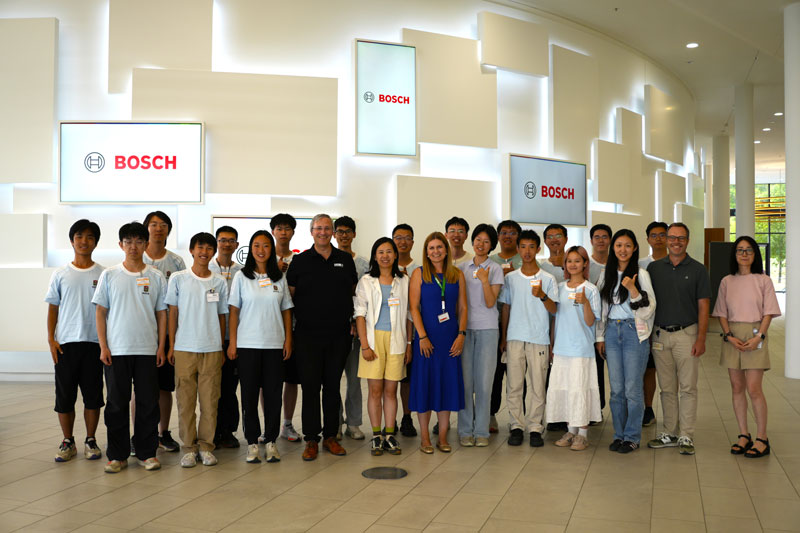
On July 30, the team visited the headquarters of Bosch Research. Bosch Research is Bosch Group’s corporate-level research and advance engineering organization dedicated to exploring emerging technologies and future innovations. Organizationally separate from the Group’s four business sectors, it focuses on cutting-edge innovation, with a global research network spanning Germany, the United States, China, India and Singapore. It is widely regarded as being among the leading industrial AI research organizations in Europe.
Researcher Micheal introduced Bosch’s global R&D footprint, patent portfolio and major areas of AI research. Christina, head of AX, joined the students for an open discussion on topics including AI safety and differences between China and Germany. The students also visited researchers’ offices and spoke directly with scientists working on the front lines of research.
Through these exchanges, the students learned that, partly in response to an aging population, Germany’s approach to AI places greater emphasis on “Industrial AI” than on general-purpose large AI models. This highlighted a broader point: there is no single template for AI development. Rather, the path a country takes is embedded in its industrial foundations and institutional choices.
02 Diverse Explorations at the Academic Frontier
EPFL
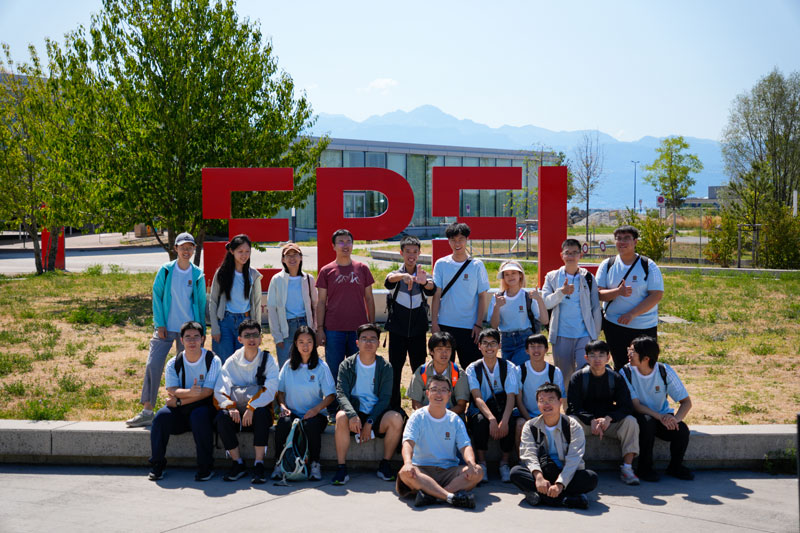
On July 22, the team visited EPFL, the Swiss Federal Institute of Technology in Lausanne. As one of Europe’s leading science and engineering universities, EPFL has distinctive research strengths at the intersection of AI and neuroscience.
In the morning, Professor Martin Schrimpf, head of the NeuroAI Lab, shared cutting-edge research in computational neuroscience and brain-inspired AI. At noon, the team met with representatives of the Chinese Students & Scholars Association Lausanne (CSSA Lausanne), gaining insights into the characteristics of Switzerland’s AI ecosystem and EPFL’s educational model of relatively broad access coupled with rigorous academic standards.
In the afternoon, the team visited the Laboratory of Computational Science and Modeling (COSMO), where they learned how machine learning can be used to replace traditionally costly quantum-mechanical simulations. The students also entered the laboratory and engaged in open discussions with researchers working at the forefront of the field.
The day at EPFL showed the team that AI can simultaneously belong to neuroscience, quantum physics and engineering design. Such interdisciplinarity is not a simple combination of different disciplines; rather, it reflects the fact that the problems themselves require insights from multiple fields.
ETH Zurich and the Institute of Neuroinformatics
On July 24, the team visited ETH Zurich and the Institute of Neuroinformatics (INI). ETH Zurich is one of Europe’s leading science and engineering universities, with an outstanding reputation in engineering and the natural sciences. More than twenty Nobel laureates, including Albert Einstein, have studied, taught or conducted research at the university. Together with EPFL, ETH Zurich constitutes a major pillar of Switzerland’s—and indeed the world’s—research and innovation landscape. The Institute of Neuroinformatics (INI), jointly established by ETH Zurich and the University of Zurich, exemplifies the interdisciplinary nature of this academic ecosystem.
In the morning, team members spoke with two senior fellow students at ETH Zurich. Although neither used AI as a primary research tool, their experiences prompted the students to consider the limits of AI: probabilistic prediction cannot substitute for controlled experiments, and a key question is how black-box models can be reconciled with the demands of verifiability in fundamental science.
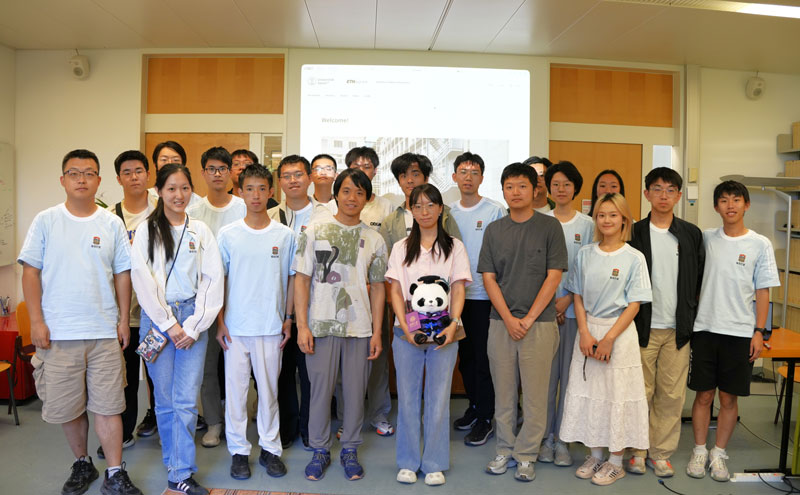
In the afternoon, three Chinese doctoral students introduced their work in areas including AI chip design and neuromorphic computing. The institute’s neuromorphic chips left a particularly strong impression on the students. Beyond the mainstream pursuit of systems that are “faster and larger,” there is another possibility—one that is “slower and more biologically inspired.” It may not prevail in today’s technological race, but it continues to probe the nature of intelligence.
Technical University of Munich and University of Regensburg
On July 29, the team visited the main campus of the Technical University of Munich (TUM), where they met with Josh of the TUM Global & Alumni Office for a discussion on the educational model and international environment of one of Germany’s leading universities. TUM has been designated a German “University of Excellence” in three consecutive rounds, and international students account for as much as 45 percent of its student body. The university embraces an entrepreneurial mindset as one of its core values and maintains close partnerships with companies including BMW and Siemens.
Toward the end of the team’s visit to Germany, the students traveled to the University of Regensburg, where a senior fellow student introduced them to the day-to-day workings and academic evaluation system of a German research university. From EPFL to ETH Zurich, and from TUM to the University of Regensburg, the team encountered the diverse landscape of European higher education. Universities in different countries and of different types each have their own approaches to education, research cultures and links with industry. Yet they share one underlying question: how to cultivate people capable of meeting the challenges of the future.
03 Conclusion: There Is No Final Answer
The two-week journey did not yield a standard answer to the question of “how AI takes shape.” Instead, it showed us that, within rigorous academic traditions, amid fragmented market rules, and in response to industrial demands driven by population aging, AI is becoming embedded in institutions, industries and human choices in different ways.
field for young people.” An alumnus remarked, “We should not merely be users in the age of AI, but also help build a future of responsible innovation.” For young people seeking to shape AI in our time, questions can sometimes be more valuable than answers. Perhaps this is the meaning of field practice: not to return with a standard answer, but to help us understand that this is where reflection on the road ahead can begin.


 2026-09-02