安刚 清华大学战略与安全研究中心特约专家
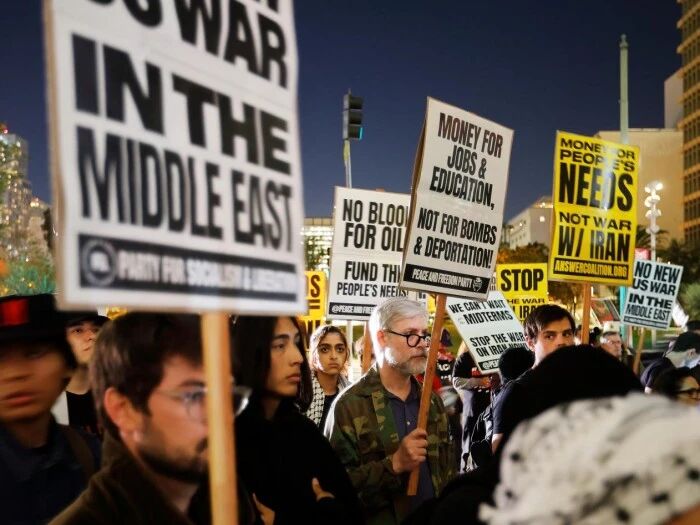
3月2日,人们在美国加利福尼亚州洛杉矶参加集会,抗议美国对伊朗发动军事打击。(新华社)
2026年2月28日,美国联合以色列,发动对伊朗的军事打击,当天就夺取了正在官邸召集会议的伊朗精神领袖哈梅内伊及一众军政高官的生命。
这是继1月3日美国特种部队突袭加拉加斯掳走委内瑞拉总统马杜罗夫妇之后,特朗普政府在短时间内又一次践踏国际关系基本准则和国际法原则,侵犯他国主权安全并对其领导人滥施暴行。对此,中国政府与国际社会众多成员一道,予以坚决反对和强烈谴责。
奉行“野兽派现实主义”政策和“以实力求和平”准则的特朗普及其政府根本不屑于对这两次海外军事行动的发起缘由做充分解释,对委内瑞拉是以“打击贩毒集团首恶”的名义,对伊朗则号称针对其“屠戮人民的罪行”替天行道。然而,两次行动背后的利益逻辑却是彼此贯通的。首先,制造寒蝉效应,击破由在拉美左翼政当权中跳得最高的几国组成的“反美之弧”和在中东由伊朗支持、操纵的“抵抗之弧”,以达震慑全球“威权反美力量”之效。其次,践行“能源贪婪”,掌控更多石油定价权,操纵国际原油市场,攫取从经济、金融到战略的多重利益,压缩出口导向型经济体的获利空间。第三,创造更多“战绩”,追求国内政治效果,迷惑基本盘,力求挽回2026年中期选举共和党日益明显的败局。
2025年1月特朗普重新执政后不久,即扬言收回巴拿马运河治权,并对丹麦的格陵兰岛提出主权要求,还声言加拿大是“美国第51州”。委内瑞拉行动得逞后,特朗普及其政府开列了新的“愿望清单”,不仅包括古巴、伊朗这样的宿敌,也包括哥伦比亚、墨西哥这样的邻国,还有加拿大、丹麦这样的盟友,恫吓它们必须正视和满足美国干预内政、侵犯主权的种种要求。
现在看来,这个“愿望清单”兑现率不低。巴拿马政府已对美方包括排斥中资公司利益在内的各种要求采取配合态度。今年1月达沃斯世界经济论坛期间特朗普同北约秘书长吕特达成密约,赋予美国自由使用格陵兰岛的经济和安全便利。2月美国以精准情报支持墨西哥联邦安全部队除掉该国头号毒枭内梅西奥·奥塞格拉·塞万提斯。5月哥伦比亚即将举行大选,与美国关系紧张的左翼总统佩特罗依照宪法不能连任。古巴民众则正在经济和燃料危机中煎熬,幕后操纵着这场危机的美国在加大对古封锁的同时,以谈判为诱饵谋划“友好接管古巴”。
过度自信的特朗普政府悍然按下对伊朗战争的按钮,未必是经过深思熟虑,更难说拥有中长期的战略规划。同以往美国在海外军事行动不同的是,特朗普政府倾向于“打了就走”,只破坏不创造,不以改造伊朗治理体制为目的。伊朗不是小国弱国,内部情况极为复杂,目前其军事体系已进入不同分支和派别各自为战的局面,美国失去了与对手进行沟通控制战争烈度的明确对象和有效手段。接下来,美国将面临如何赢、如何退出的大问题,不排除战事不顺、损失超预期,无法速战速决,不得不持续投入更多战争资源。
就算特朗普政府自我宣布达到目的,敲着胜利锣鼓离开伊朗战场,也必然在中东留下一个烂摊子:一个缺乏有效中央管控、局部极端化的伊朗对地区和平稳定和美国的硬软实力及盟友体系将造成长期反噬。更为重要的是,特朗普再度上任一年多来四处出击所掀起的疾风骤雨正在形成“一鼓气方盛,再鼓则气衰,三鼓则气竭”的轨迹,并且在美国国内加剧了政治撕裂甚至MAGA阵营的内部分化。因而美国政府在中期选举前对特定国家采取新的大规模犯险行动的可能性正在降低。
悲哀在于,特朗普政府的种种行径给国际秩序造成巨大冲击与破坏,将把世界带向何方?
特朗普第二任期初年,在“美国优先”旗号下对美国的全球战略进行了相当激进的调整,基本方向是,彻底摒弃自由主义依托经济全球化维护美国主导地位和拓展美国制度模式的霸权路径,转而恢复帝国主义的方式,以美国本土和西半球为战略优先,“印太”次之,大幅削减在非核心区域的军事存在和财政投入,集中应对“系统性挑战”。特朗普政府也在改造美国全球同盟体系的运行模式,将其转向美国的单边主义战略工具,而非像过去那样优先履行对盟友的保护责任。
指导当下美国全球战略调整的基本方针是所谓“门罗主义的特朗普推论”——不允许美国以外的任何大国染指西半球事务,不允许美国以外的任何国家对西半球以外的地区形成绝对主导。
日益明显的是,特朗普政府正在进行的全球战略调整并非简单的收缩,而是重新配置资源,充分利用现有军事、技术优势,整治异己、威慑大国、胁迫伙伴,全力维护美国的全球霸权地位,延缓美国实力的下降趋势。特朗普深知自己的权力生涯仅剩两三年,“只争朝夕”地在世界各地拣“软柿子”舞枪弄棒,也是为了后期推进全球战略资源的重置扫清干扰源。
2月14日,美国国务卿鲁比奥在第62届慕尼黑安全会议上发表的演讲中向欧洲伙伴们发出了与美国携手共建国际新秩序的邀请,一些欧洲政要做出了“深感欣慰”的回应。鲁比奥在登机前往慕尼黑之前,满脸凝重地向记者宣告,“旧的世界已经不复存在,我们生活在一个地缘政治的新时代”。
同在慕安会现场的傅莹大使得出自己的观察结论:美欧口中已然“终结”的秩序是战后美国发挥主导作用、西方占尽优势、美国利用经济全球化延续繁荣的秩序。美欧想要构建的新秩序是西方文明继续居于中心位置、中俄等所谓“威权国家及其联盟”受到足够压制且不能“胁迫”西方、全球南方处于从属地位的新型霸权秩序。美欧为构建这套新秩序需要重新分工——欧洲更多自主承担防务责任,美国以西半球为依托重建实力地位,更集中地对付中国。归结成一点,便是形成联手阻止未来世界秩序构建主导权旁落的共同意志和行动。
这一观察如果属实,却是特朗普政府的一厢情愿。特朗普政府代表的“新帝国主义”美国正把国际秩序带入礼崩乐坏、“力量即规则”的丛林时代。然而,中国和众多全球南方国家以及部分西方中等强国不会任由美国一手谱就的国际秩序哀歌吞噬世界和平与发展的一面,将加强协调合作,发挥平衡作用,推动历史穿越霸权欺凌、零和竞争的隧洞,走向基于真正多边主义的多极光明。
“New Imperialist”and Elegy for the International Order
On February 28, the U.S., in coordination with Israel, launched a military strike against Iran, claiming the lives of Iran’s Supreme Leader Ayatollah Ali Khamenei, who was convening a meeting at his official residence, along with a host of senior military and political officials.
This was yet another instance of the Donald Trump’s administration trampling on the fundamental norms of international relations and principles of international law, violating the sovereignty and security of other nations, and perpetrating atrocities against their leaders—following the January 3 raid by U.S. special forces in Caracas that abducted Venezuelan President Nicolás Maduro and his wife.
In response, the Chinese Government, alongside numerous members of the international community, has resolutely opposed and strongly condemned these actions.
The aggression and its stated logic
Trump and his administration, adhering to a “new form of brutalism and candor in U.S. foreign policy”—a pragmatic, aggressive approach that prioritizes power, self-interest and practical outcomes over idealism or diplomatic niceties—and the principle of “peace through strength,” has shown little interest in providing reasons to justify these overseas military operations. They framed the Venezuela operation as a strike against drug cartels and the attack on Iran as bringing “justice for the people of Iran.”
Yet, the underlying logic of these actions was interconnected. First, they aim to create a chilling effect, dismantling the “arc of anti-Americanism” led by the most vocal left-wing governments in Latin America and the “axis of resistance” supported and run by Iran in the Middle East, thereby intimidating global “anti-American forces.” Second, they pursue the energy greed agenda by gaining more control over oil pricing and manipulating the international oil market to seize multiple economic, financial and strategic benefits, thereby limiting the profits of export-oriented economies. Third, they seek to generate more accomplishments for domestic political effect, consolidating the Republican base in an attempt to reverse the party’s increasingly apparent losses in the 2026 midterm elections.
The Iranian quagmire
Shortly after Trump returned to power in January 2025, he threatened to reclaim control over the Panama Canal and asserted sovereignty claims over Greenland, part of Denmark. He even suggested that Canada should become the “51st state” of the U.S. Following the successful operation in Venezuela, the Trump administration unveiled a new wish list, which not only includes long-standing adversaries like Cuba and Iran but also neighbors such as Colombia and Mexico, and even allies such as Canada and Denmark. It has intimidated these nations into complying with U.S. demands for interference in their internal affairs and violations of their sovereignty.
It now appears that this wish list has a high rate of fulfillment. The Panamanian Government has already adopted a cooperative stance toward U.S. demands, including those that exclude Chinese companies from benefiting. During the World Economic Forum in Davos this January, Trump “formed the framework of a future deal with respect to Greenland” with NATO Secretary-General Mark Rutte. In February, the U.S. provided precise intelligence to Mexican Federal Security Forces, enabling them to eliminate the country’s top drug lord, Nemesio Oseguera Cervantes. In May, Colombia is set to hold presidential elections, and its leftist president, Gustavo Petro, who has strained relations with the U.S., is constitutionally barred from seeking reelection. Meanwhile, the Cuban people are suffering under economic and fuel crises, with the U.S., which orchestrates these hardships, intensifying its blockade while using negotiations as bait to plot a “friendly takeover” of Cuba.
The overly confident Trump administration’s rash decision to press the button on war with Iran may not have been well-considered, let alone part of a medium- to long-term strategic plan. Unlike previous U.S. overseas military operations, the Trump administration appears inclined to “hit and run”—destroying without building, without aiming to transform Iran’s governance structure.
Iran is neither a small nor weak nation; its internal dynamics are exceedingly complex. Currently, its military apparatus has fragmented into various branches and factions, leaving the U.S. without a clear counterpart or effective means to communicate and control the intensity of the conflict. Moving forward, the U.S. will face challenges in determining how to achieve victory and how to exit, with the possibility of prolonged conflict, unforeseen losses and the need to continuously commit more resources.
Even if the Trump administration declares victory and withdraws from the Iranian theater amid triumphant fanfare, it will inevitably leave behind a chaotic mess in the Middle East. An Iran lacking effective central control and experiencing localized radicalization will, in the long run, backfire on regional peace and stability, as well as on America’s hard and soft power and its alliances. More importantly, the storm unleashed by Trump’s aggressive actions since his return to office has followed a trajectory of “striking with force initially, then weakening on successive strikes.” This has exacerbated political divisions and even factional splits within the “Make America Great Again” (MAGA) camp, making the likelihood of launching new large-scale risky actions against specific countries before the midterm elections diminishing.
The tragedy lies in the immense disruption and damage inflicted on the international order by the Trump administration’s actions and where it is leading the world.
The strategic shift
In the first year of Trump’s second term, under the banner of “America First,” his administration has undertaken a rather radical adjustment of U.S. global strategy. The basic direction was to completely abandon liberalism’s reliance on economic globalization to maintain U.S. dominance and expand the American model of governance, instead restoring imperialist methods. It prioritized the U.S. homeland and the Western Hemisphere, with the Indo-Pacific taking a secondary role. The administration greatly reduced military presence and financial commitments in non-core regions to focus on addressing “systemic challenges.” It is also reshaping the operational model of America’s global alliance system, transforming it into a unilateral strategic tool rather than prioritizing the protection of allies as in the past.
The fundamental principle guiding the current adjustment of U.S. global strategy is the so-called “the Trump Corollary to the Monroe Doctrine”—forbidding any major power outside the Western Hemisphere from interfering in its affairs and prohibiting any nation from achieving absolute dominance over regions beyond the Western Hemisphere.
It is increasingly evident that the strategic adjustment being undertaken by the Trump administration is not merely about retrenchment but about reallocating resources to fully leverage existing military and technological advantages. The goal is to suppress adversaries, deter major powers and coerce allies, all to maintain America’s global hegemony while slowing its decline. Trump is acutely aware that his time in power is limited to just two or three years, and he is hastily engaging in strategic “pick-and-choose” actions in different parts of the world to clear the path for the later restructuring of global strategic resources.
On February 14, U.S. Secretary of State Marco Rubio, in his speech at the 62nd Munich Security Conference, extended an invitation to European partners to jointly build a new international order. Before boarding his flight to Munich, Rubio grimly told reporters, “The old world is gone, frankly, the world I grew up in, and we live in a new era in geopolitics.”
Chinese diplomat Fu Ying, also present at the conference, offered her observations: The order that the U.S. and Europe claim has “ended” is one in which the U.S. played a dominant role, the West held all the advantages, and the U.S. leveraged economic globalization to sustain prosperity. The new order they seek to build is still a hegemonic one where Western civilization remain central, their so-called “authoritarian states and their alliances” like China and Russia are sufficiently suppressed and unable to “threaten” the West, and the Global South remains subordinate.
To build this so-called new order, the U.S. and Europe need to reconfigure their roles—Europe assumes more responsibility for its own defense, while the U.S. rebuilds its strength to focus more intently on countering China. In essence, the goal is to form a joint will and action to prevent the leadership of the future global order from slipping away from the West.
If this observation holds true, it reflects Trump’s wishful thinking. The “new imperialist” America represented by the Trump administration is dragging the international order into an era of chaos, where “might makes right” dominates.
However, China, along with many Global South countries and some medium-sized Western powers, will not allow the international order dictated by the U.S. to swallow up global peace and development.
Instead, they will strengthen coordination and cooperation, play a balancing role, and push history forward beyond hegemonic bullying and zero-sum competition, toward a future based on true multilateralism and a bright, multipolar world.
本文2026年3月5日首发于“北京周报网”